Home Safety Alert: The 5 Most High-Risk Electrical Panels
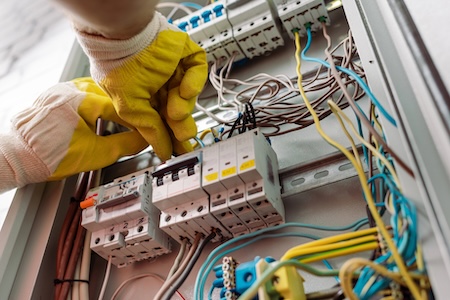
Modern homes demand more power than ever before. If your garage or basement houses one of these five obsolete panels, your home may be at a significantly higher risk for electrical fires or equipment failure.
1. Federal Pacific Electric (FPE) “Stab-Lok”
The Danger: Documented high failure rates. These breakers often fail to trip during an overload or short circuit, allowing wires to overheat. In some tests, these breakers failed to trip up to 60% of the time.
Active Years: 1950s–1980s.
How to Identify: Look for the “Stab-Lok” or “Federal Pacific Electric” name on the interior door label.
Visual Cue: Distinctive red or orange handles on compact, narrow breakers.
2. Zinsco / GTE-Sylvania
The Danger: The breakers are known to weld or melt to the bus bar. This means the breaker may appear to be off while electricity is still flowing, creating a serious shock and fire hazard.
Active Years: Popular through the 1970s.
How to Identify: Labels often read “Zinsco,” “GTE-Sylvania,” or “Magnetrip.”
Visual Cue: A single vertical column of slim breakers with brightly colored handles in red, blue, green, and gray.
3. Pushmatic (Bulldog)
The Danger: These panels use a push-button mechanism that tends to stick over time. They are difficult to reset, lack modern AFCI and GFCI protection, and replacement parts are extremely hard to find.
How to Identify: Look for the “Pushmatic” or “Bulldog” branding.
Visual Cue: Square push-buttons arranged in a grid instead of traditional breaker switches.
4. Challenger / Bryant Load Centers
The Danger: While many Bryant panels were well built, specific Challenger models, which Bryant later absorbed, are prone to overheating and arcing at the bus bar connection. These panels often appear modern while hiding significant internal heat damage.
Active Years: 1980s–1990s.
How to Identify: The door label will state “Challenger” or “Bryant.”
Visual Cue: Black breakers that resemble modern designs, sometimes showing subtle browning or heat discoloration around the casing.
5. Old Fuse Boxes (Obsolete Service)
The Danger: Most fuse boxes provide only 30 to 60 amps, which is inadequate for modern HVAC systems and appliances. Homeowners often over-fuse circuits, such as using a 30-amp fuse on a 15-amp circuit, which is a leading cause of electrical fires.
How to Identify: Commonly found in homes built before 1960.
Visual Cue: Screw-in glass fuses resembling lightbulbs and pull-out cartridge fuse blocks.
Practical Advice: What Should You Do?
If you identify any of these panels in your home, do not attempt to repair them. Because the designs are fundamentally flawed or obsolete, replacement is the only safe solution.
Consult a Pro: Have a licensed electrician perform a load calculation and safety evaluation.
Upgrade: Replace the panel with a modern, UL-listed unit from a trusted brand such as Eaton, Siemens, or Square D.
Insurance & Resale: Upgrading your electrical panel can help lower insurance premiums and is often required when selling a home.